By Austen Ivereigh 6 December, 2025
Six months after Pope Leo XIV’s election, it is clear that the long period when the Catholic Church was rooted in European culture ended with the papacies of John Paul II and Benedict XVI. Francis and now Pope Leo have opened a new global, postmodern era.
What the Church is losing—and what it is searching for
Every time I give a talk in a parish to explain the synod on synodality, I am told, “We never hear anything about this from our priests or bishops”. I thought at first this was a complaint about a lack of communication. But the pain goes deeper. There is a lack of direction, of vision. People see shrinking, ageing congregations, parishes merging and closing, and pews empty of young people. They see a death, but struggle to understand why it is happening, and what comes after it. They want to know where God is in it all, what the vision of the future is, because surely it can’t just carry on as usual?
Sensus fidei and the guidance of the Holy Spirit
This is the sensus fidei – the believing people’s instinct of faith – in play. They are right to ask, for the Spirit has spoken to the Church. A discernment of the signs of the times has happened, and with it a vision: of how the Church must now change in order to evangelize in this new era. That discernment long predated the synod on synodality, but the synod confirmed it. It is the vision that shaped the Francis pontificate, and is now being taken forward by Leo. I call it “the road from Aparecida”.
What is “the road from Aparecida”?
Aparecida as an event
Aparecida means “appeared” in Portuguese, because at the heart of the Brazilian national shrine of Nossa Senhora da Aparecida, about 100 miles north-east of São Paolo, is a little statue of Our Lady that turned up in the nets of poor fishermen on the River Paraiba in 1717. Their next haul was so heavy with fish they were forced back to port. That was the first of many miracles, starting a devotion that led to the building of the world’s largest cathedral after St Peter’s.
The 2007 Aparecida conference
It was at Aparecida that in May 2007 the Latin-American bishops met for a landmark three-week meeting whose conclusions Cardinal Jorge Mario Bergoglio of Buenos Aires was in charge of drafting. Aparecida set the direction of Francis’s pontificate – and it has also set that of Leo. Its achievement was not just to grasp the times we are in – what Aparecida called the “change of era” – but, more importantly, to grasp how the Spirit was calling the Church to reform in order to evangelize in this new context.
It is a vision of the future unlike any other in the Church at this time. If such a thing can be said of a road map, it has the air of Pentecost – and so it was seen, both by those who were there and by theologians. Clodovis Boff, for example, said it was not only the best document ever produced by a regional episcopate, but “a surprise of the Spirit, for nothing had led anyone to expect a document of that quality”.
There was also – and it was key – a road to Aparecida. This was the fifth so-called General Conference of CELAM, the regional umbrella body of the bishops’ conferences of Latin America and the Caribbean, covering a continent where close to half of the world’s Catholics live; and it was the first general conference in 15 years. But unlike previous conferences, it was prepared by an unprecedented three-year process of consultation and discernment – a process that we now call “synodal”. Across the continent at every level – local, national, regional – honest, hard questions were asked, and the ordinary faithful invited to answer. Studies and surveys were commissioned and experts asked to say how the Church was seen by society, the media, young people. I was invited to contribute to one of these meetings in Bogotá, Colombia, back in 2006, and wrote for The Tablet about it, amazed at the humility of the process, which, I said, would have been unthinkable in Europe. It was, at that point, by far the biggest such process ever carried out by a regional Church.
Diagnosing the “change of era”
Even before the continent’s bishops assembled at the shrine, the expression “change of era” (cambio de época) had begun to appear in the documents. It is an expression Francis used regularly – in Evangelii Gaudium it is rendered as “epochal change” – as has Leo since his election. It comes from a distinction made by sociologists between an era of change – where societal changes occur within an existing, stable cultural framework – and a change of era, in which that framework is shattered by rapid social and technological advances that surpass the capacity of human culture to grasp them. Changes of era, usually lasting many decades, are turbulent transitions from one epoch to the next. Institutions fail; elites look helpless and self-serving; feeling powerless, people are tense and anxious.
Aparecida saw that the Church was beginning to fail to evangelise. The transmission belts of faith were fraying and breaking: a gap had grown between the institution and the people. The change of era was affecting “the traditional forms of life, relationship, communication and transmission of faith”, the document said, and it highlighted globalisation, individualism, the weakening of institutions, the collapse of grand narratives, the displacement of people, the ecological crisis, as well as the expulsion of Christian values from law and culture. In response Aparecida called for “an ecclesial renewal, involving spiritual, pastoral and institutional reforms”.
From Francis to Leo: a vision handed on
At one of the daily Masses at the shrine, Cardinal Bergoglio gave a famous homily in which he described the Church as like the bent-over woman in Luke’s Gospel, closed in on itself, with the “People of God off over there”. It wasn’t that people were leaving the Church so much as the Church leaving the people. Bergoglio spoke of the Church needing to “come out of itself”, to transcend its existing frameworks and mindset, in order to be guided by the Spirit to the peripheries. The 200 assembled bishops, convinced after hearing him that he was “anointed” – the word various of them have used to me – stood to applaud. Six years later, in a speech to the cardinals in Rome in March 2013, Bergoglio gave the same diagnosis, using the same images and words. They also clapped. Then they elected him pope.
For his first few months Francis gave visitors copies of Aparecida, and told them to read it if they wanted to understand what he was up to. But then came Evangelii Gaudium in November 2013. The same team that had helped Bergoglio put together the 200-page Aparecida document had helped Francis write his thrilling exhortation, which captured Aparecida for the universal Church. And so the Francis election – and in particular, Evangelii Gaudium – marks the moment when the Latin-American Church became the dynamic “source” of today’s universal Church, as throughout history regional Churches have been sources that the rest of the Church reflects (think Spain and Italy at the time of the Counter-Reformation, or France and Germany at Vatican II).
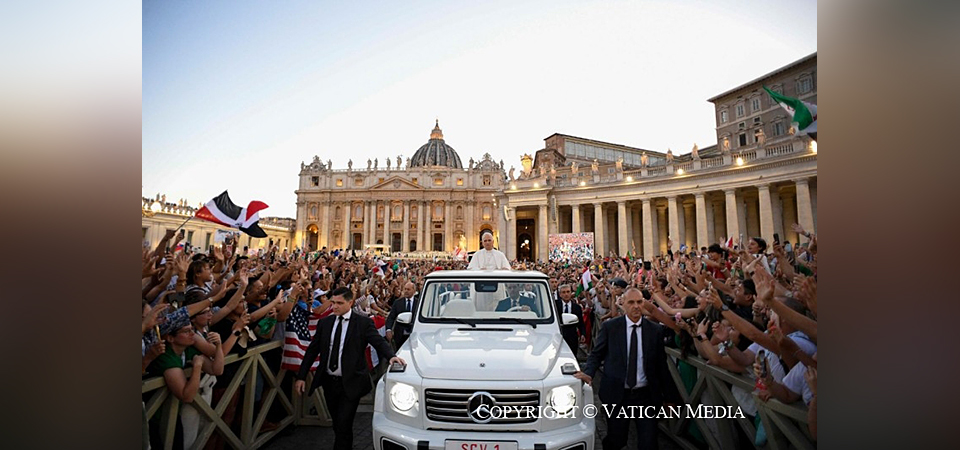
The headlines on 8 May 2025 were, rightly, about the election of the first north American pope. But in terms of Leo’s ecclesial vision, the more important news was the cardinals choosing the second Latin-American pope, for Robert Prevost is deeply shaped by his decades as a pastor, missionary and bishop in the Peruvian Church, and by the vision that matured at Aparecida. Addressing the cardinals on 10 May, when Leo spoke of continuing on the journey Francis had begun, he pledged himself to a “renewal of the path of Vatican II which Francis set forth in Evangelii Gaudium”.
Let’s decode that. “The renewal of Vatican II” is what the Latin-American Church has long spoken of as its continental mission, while “the path of Vatican II which Francis set forth in Evangelii Gaudium” is, of course, the reception of Vatican II by the Latin-American Church that matured in Aparecida.
Three pillars: mission, conversion, synodality
Leo listed a number of what he called “fundamental points” from that exhortation, three of which were key to the Aparecida discernment of the change of era: the return to the primacy of Christ in proclamation; the missionary conversion of the Church; and synodality, referring to the agency of the People of God and the sensus fidei.
The story of the 2025 conclave, then, is the extension and deepening of the road from Aparecida. Leo’s election showed that the Francis era was not a chapter that can now be shelved, as some had hoped, but the opening of a new story that will develop over this next generation. As the Czech priest-prophet Tomáš Halík put it to me: if John Paul II and Benedict XVI brought to a close the long era of the European Church’s dialogue with modernity, Francis is the first pope of a new, global, postmodern era. To which we can add: and Leo is the second.
The most important thing that happened at Aparecida was that first, essential step on the path to conversion: the abandonment of illusory self-sufficiency and the embrace of humility. The Aparecida document began with a rejection of “those who see only confusion, dangers and threats” in secularisation, and who respond to it with “worn-out ideologies or irresponsible aggression”. The Latin-American bishops essentially asked: “What must we do? How is the Spirit asking us to change in order to carry out our mission in these new circumstances?” Too often the Church had failed to embrace the historical consciousness – discerning the signs of the times – the Second Vatican Council had called for. Instead of discerning and reforming in response to historical shifts, the default was lamentation and condemnation. That’s why Bergoglio used the Lukan image of the bent-over woman to describe a Church doubled down, withdrawn into itself, a prickly island of the pure.
Pope Francis explained this well in an address to bishops, clergy and pastoral workers in Quebec in 2022, when he contrasted the negative with the discerning response to secularisation. The negative response focussed on the loss of power and influence, and how to recover them: the stance of Christian nationalism or culture-war strategies. This is not a Christian response, said Francis, because it denies the Incarnation, and discloses a worldly attachment to power and social relevance. The discerning response, on the other hand, humbly allows us to see such attachments as unhealthy, while opening us to the gift of conversion. By embracing the loss of power and status in secularisation, the Church can better witness to the mercy of God in humility.
It was clear to the bishops in Aparecida that Christianity was no longer religio: an inherited identity, passed down through culture and institutions. The era of mass, culturally mediated Christianity was over; ours is a new apostolic age. Parish, school and family all remained vital – Aparecida has many pages dedicated to them – but if they tried simply to carry on as before they would be unable to resist the new culture of globalised individualism and consumerism. Faith would now spread, as in the early Church, by contagion, from person to person, and had to include the experience of encounter with God’s mercy. Without this “primary encounter”, as Aparecida called it, liturgy, sacramental preparation and doctrine would make ever less sense.
In a series of talks Cardinal Bergoglio gave back in Buenos Aires, he would continually stress that change had to come. Unless parishes became living communities of faith – places of belonging and communion, not just sacramental service stations – and unless the Church raised up missionary disciples, formed in faith, working for the Kingdom, enabling the encounter with Christ, evangelisation would all make less and less sense. Aparecida called this transformation a “pastoral and missionary conversion”. Priests must foster ministries and charisms, build participation and communion, help form the responsibility and agency of the People of God. “The building up of citizenship, in the broadest sense, and the building of ecclesial belonging in lay people, is a single, unique movement,” Aparecida said.
The greatest obstacle to this was what Francis referred to as “clericalism”, a corruption of the priesthood in which clergy assume all authority and agency and the Church is equated with the ordained. Lay people collude in this two-tier Church in order to shirk their baptismal responsibility. Evangelii Gaudium bears the scars of six years’ implementation of Aparecida, which had revealed the scale and breadth of the resistance to it: the grey mundanity of the keep-the-show-on-the-road mentality, the nostalgia for the liturgy of the past, the remote, abstract, self-referential “museum” Church, priests preaching a “loveless moralism” (eticismo sin bondad), reducing the Kingdom to a series of ethical precepts in trite, bland homilies. Francis took on spiritual worldliness, acedia, Pelagian self-reliance and the “sterile pessimism” of those who give in to “an anxious and self-centered lack of trust”. It was a strong tonic.
Yet Evangelii Gaudium also bears witness to the joy of embracing the conversion Aparecida called for. The most thrilling passages are about the life of the Spirit catching fire in the People of God, releasing its evangelising energies. Francis returns, over and over, to the primacy of grace, the way God’s saving love precedes moral and religious obligation, the presence of Christ in the poorest, the evangelising power of popular piety, and the priority of the proclamation of the Kingdom. It is about what happens when the Church “comes out of itself ” to receive the power of the Spirit and put Christ at the centre. It is a Church learning to live not for itself, but for mission, in the change of era. To read about Leo’s life in Peru is to be struck by how firmly Prevost operated within this vision. When he spoke on 10 May about Evangelii Gaudium as the reinvigoration of Vatican II in our time, he, too, was speaking from his experience implementing it as bishop of Chiclayo after 2014.
During the papal transition I was often asked in interviews about Pope Francis’ legacy: was his a reform of style or of substance? But in evangelisation, style is substance. The great historian of Vatican II, John O’Malley SJ, said style was the first of the “issues-behind-the-issues” at the Council, the other two being collegiality and historical consciousness. The issue of style was the question of how the Church relates to humanity: whether with a juridical, command-and-control style born of the neo-Christendom paradigm of modernity, or a pastoral one – that is, accompanying, urging, exhorting and so on – which is appropriate for a secular era. The breakthrough at the Council was to recognise that in a post-Christendom context, the Church could better reflect the way in which God relates to us – washing our feet – by abandoning the logic and language of power.
God’s style and a culture of tenderness
Francis called this “God’s style”. He captured it in his ear-worm metaphors: the battlefield-hospital, the Church as mother not tollhouse, and so on. And of course he embodied it and performed it all the time in his words, actions, choices and projects, showing forth the God who is close and concrete, tender and merciful, attentive and discerning, humble and hospitable. People felt seen, recognised, and valued by Francis; they came alive in his presence, awakening to their dignity – just like those who met Jesus. He called this the “culture of tenderness”, and while it was natural to him, it was conscious: the need for the Church to embrace God’s style was also the discernment of Aparecida, which invites the faithful to meditate on Jesus’ effect on people. For Francis the Church had to embody this style, beginning in the Roman Curia. When people come looking for God in this age of transactional, impersonal power, it is this quality of the divine their hearts yearn to find: ministeriumnot potestas; the “culture of tenderness”, in contrast to the “throwaway culture” of this age.
And here, in this question of style, is where I particularly see the Francis river overflowing into Leo’s. The dean of the college of cardinals, Cardinal Giovanni Battista Re, had spoken in his homily at Francis’ funeral of how his “charism of welcome and listening”, so in tune with “contemporary sensibilities”, had “touched hearts, seeking to awaken moral and spiritual energies”. The cardinals then chose Robert Prevost, explaining how touched they were by how he was with them: his graciousness, his attentive listening, his capacity to create consensus. Whether or not they would or could articulate it, the cardinals grasped that a pope with God’s style is key to evangelising in the change of era. The content of faith, fides quae (belief, doctrine), remains vital; but the doorway to it now is fides qua, behaviour of faith – the mindset, the way of being.
This makes sense, for in an earlier apostolic age, before the Church was embedded with the state, Christian communities captivated not by wealth or status but by their habitus of patientia, a willingness to live and to endure in confident expectation of God’s action. Theirs was the joyful, hopeful mindset of the Beatitudes, while their actions reflected God’s indiscriminate caritas.
How does the Church take on God’s style? This is the gift of synodality, which under Francis came to be seen as the essential means of pastoral and missionary conversion. This, too, goes back to Aparecida: a “permanent pastoral conversion” is what happens when the whole People of God – lay, Religious, priests, bishops – listen to and discern what the Spirit is saying to the Church through the signs of the times.
Synodality as a practical path
Francis developed that vision in the famous speech he gave on 17 October 2017 to mark the fiftieth anniversary of the institution of the Synod of Bishops, and he gave it concrete form in the synod on synodality, so that the whole People of God might discover its agency. The template for the synod on synodality journey – consultation of the people through spiritual conversation, followed by stages of discernment at national and regional level, concluding with the meeting of bishops – was created on the road to Aparecida. And when you set the synod’s Final Document alongside Aparecida/Evangelii Gaudium the similarity is striking – further proof that the Spirit has spoken to the Church in our time. No wonder that synodality was the celebrity issue at the conclave.
“Through the synodal process,” Pope Leo told the clergy of Rome on 19 September, “the Spirit has inspired the hope of an ecclesial renewal, able to revitalise communities so that they may grow in the Gospel style, in closeness to God and in the presence of service and witness in the world.” He went on to describe synodality’s fruits – valuing services and charisms of all, enabling the participation of all, creating habits of discernment and co-responsibility – in terms that are straight out of Aparecida. And he made clear that business-as-usual was not going to cut it, that formation was urgent. “We are living through a formative emergency,” he said, “and we must not delude ourselves that it is enough to carry on with a few traditional activities to maintain the vitality of our Christian communities.”
The Synod’s Final Document was approved in October last year and became part of papal teaching. In March this year Francis signed off on a three-year process of reception to involve the Church at every level in implementing it. Leo confirmed this process in June, and in July the synod office in Rome issued guidance for its implementation, noting that while many local Churches are “enthusiastically pursuing” synodality, others are hesitant or taking their first steps. Bishops resisting, says Pathways for the Implementation Phase of the Synod, need to “open themselves to the action of the Spirit, first of all by listening to their own resistance”.
Conclusion: the road that has reached our shores
After a year of silence, the bishops of England and Wales had synodality on their agenda for their plenary meeting this week. When I think back on all those who asked me, “What is happening? Why do we hear nothing?” I find myself praying that the bishops rise to the challenge of the hour. It means passing on the good news: that under Francis and now Leo, the times have been discerned, and the Spirit has spoken to the Church. There is a road ahead. It began in Brazil, passed through Rome, and is at our shores. And if we open ourselves to what the road has brought us, it will surely carry us forward.
Austen Ivereigh is a fellow in contemporary church history at Campion Hall, Oxford.
This article was originally published in the 15 November 2025 edition of The Tablet, the International Catholic Weekly. Reproduced and used in full with permission from Austen Ivereigh.